Tag Archives: classification

新世界のホオジロ New World Sparrows


新世界の9本の初列風切科の中にホオジロ科が入っています。 The family of Emberizidae, is among Emberizoidea, Finches in the New World.

このホオジロ科は分類上、過去に何回も分類し直しされてきました。今後も再編される可能性があります。それだけいつも私たちの生活に寄り添って生きている重要なグループだということでしょう。 This family of Emberizidae has been reclassified many times in the past for taxonomic reasons. There is a possibility that it will be reorganized in the future. I guess it is such an important group that has always lived close to our lifestyles.

ホオジロ科は更に旧世界ホオジロ類と新世界ホオジロ類に別れています。ここでは、アメリカ在住の私が出会った新世界のホオジロ類だけを扱います。 This family is further divided into Old World Emeriza and New World Sparrows. Here, I will deal only with New World Sparrows that I have encountered while living in the United States.

表1 Table 1

補足です。旧世界や日本でよく見かけるスズメはホオジロ属には入っていません。ホオジロと似ているのにね。9本の初列風切の外に区分されているので、初列の羽の数が違うのかもしれません。 Supplementation. The sparrows (Eurasian Tree Sparrow) commonly seen in the Old World and Japan are not in the genus Emberizidae. Even though they resemble Emberizidae birds, they are classified outside of the Nine-primaried oscines. I am not sure, but their primary feather count may not be 9.
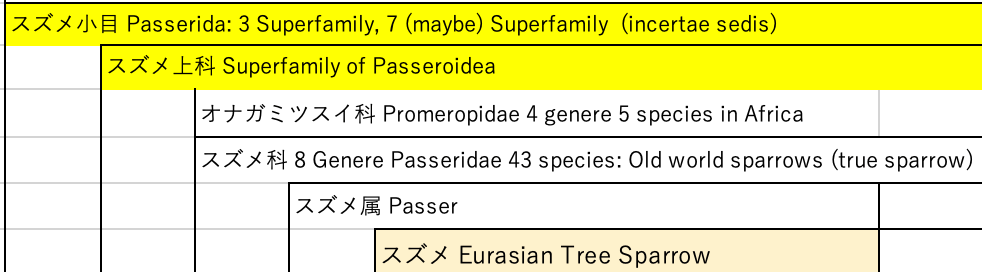
表2 Table 2

話を戻します。表1の中、ピンクでハイライトされた10種のみを順にご紹介します。いずれも北米でよく見かける鳥です。 Back to the story. I will introduce only the 10 species highlighted in Table 1 in order.

最初の鳥はウタスズメです。名前の通り、春にはオスの歌声が低木地帯などに響きます。オスとメスの外見状の違いはないようです。 The first bird is the Song sparrow. As the name implies, the male’s song echoes through shrublands and other areas in the spring. There seems to be no apparent difference between the male and female.

ウタスズメ Song Sparrow

主食は虫です。北米全土の低木で見かけることができます。 Its primary food is insects. They can be found in shrubs throughout North America.

次の鳥はミヤマシシドです。裏庭の常連客です。来る時は必ず2-3匹以上で来ます。彼らは群れで行動する鳥なんですね。 The next bird is White-crowned Sparrow. It is a regular visitor to our backyard. Whenever they come, they always come in groups of two or three or more. They are birds that act in flocks.
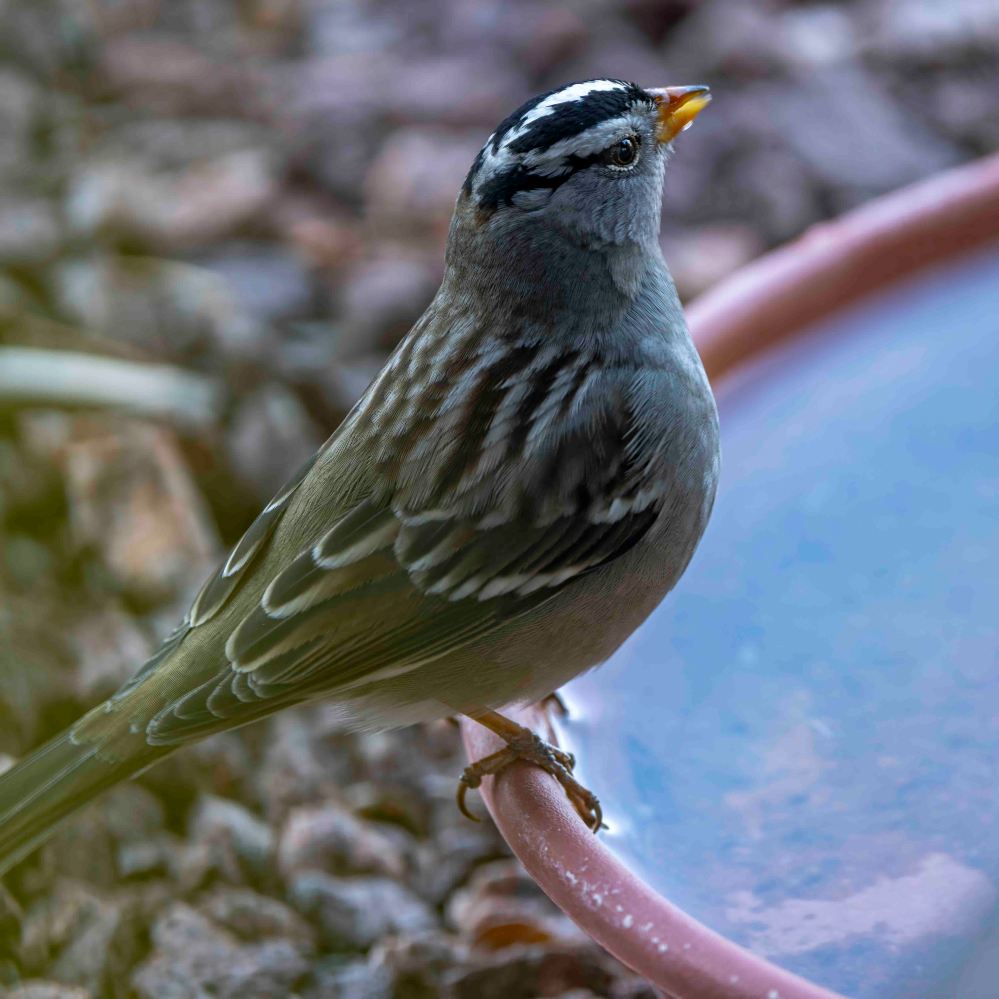
ミヤマシトド White-crowned Sparrow

生息域は北アメリカ全土なので、大抵どこに行ってもみられる鳥です。あまりにもよく見かける鳥なので、写真がなく、慌てて撮りました。主食は虫です。 Its habitat is all over North America, so it is a bird that can be found almost anywhere you go.It is so common that I was in a hurry to take a picture of it because I didn’t have any. Its primary food is insects.

ユキヒメドリも北アメリカ全土で見られる鳥です。木が多い場所を好むようで、地面に落ちた種を食べているようです。 The Dark-eyed Junco is another bird found throughout North America. They seem to prefer areas with lots of trees, and eat seeds that have fallen to the ground.

ユキヒメドリ Dark-eyed Junco

半砂漠気候の今の家に引っ越してきてからは、あまり見ませんが、昔、カリフォルニアに住んでいた時は家の周りでもよく見かけていました。 I don’t see them much since we moved to our current residence in a semi-desert climate, but I used to see them around our house when we lived in California.

ユキヒメドリとは対照的に、アゴグロヒメドリは、この地に引っ越してきてから初めて出会った鳥です。実際、北米の南西部にのみ生息しているようです。 In contrast to the Dark-eyed Junco, the Black-chinned Sparrow is a bird I have encountered for the first time since moving to this area. In fact, they seem to be found only in the southwestern part of North America.

アゴグロヒメドリ Black-chinned Sparrow

この写真のアゴグロヒメドリはオスで、春の繁殖期だったのでアゴが黒くなってます。でも、それ以外の季節は、メスと同様にアゴも目の周りも黒くなっていません。だから、多分、繁殖期以外に見かけても私には識別できないと思います。小さい虫を食べます。 The Black-chined Sparrow in this photo is a male, and his chin is black because it was the spring breeding season. But in the other seasons, neither the jaw nor the area around the eyes are black, as is the case with the female. So I probably wouldn’t be able to identify them to you if I saw them in the non breeding seasons. They eat small insects.

次の鳥、チャガシラヒメドリの特徴は、なんといっても頭の茶色の帽子です。この鳥も、北米に生息していますが、最近は見かけません。やはり、カリフォルニア近辺に多く住んでいそうです。 The next bird, the Chipping Sparrow, is characterized by the brown cap on its head. This bird is also found in North America, but I have not seen them recently. It seems to live mostly in the vicinity of California.

チャガシラヒメドリ Chipping Sparrow

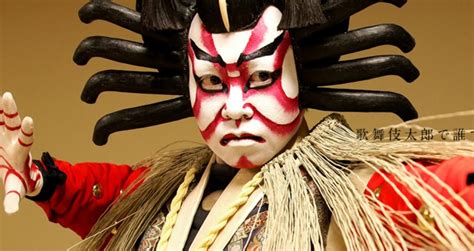
次は、ヒバリヒメドリです。草原地帯に住んでいて、地面に落ちた種や小さな虫が主食です。この鳥、顔のくっきりとした模様が、歌舞伎で見かける悪役の顔に似ていると思いませんか?すっかり好きになりました。 Next is the Lark Sparrow. It lives in grassland areas and its main food is seeds and small insects that have fallen to the ground. By the way, don’t you think the distinct pattern on this bird’s face resembles the face of a villain seen in Kabuki theater? I’ve grown quite fond of it.

こちらが、歌舞伎の舞台。雰囲気が似ていると思うのは私だけでしょうか。 Here is a Kabuki stage. Am I the only one who thinks the impression is similar?

さて、こちらはノドグロヒメドリです。アゴグロヒメドリの黒い色がアゴでストップしているのに対し、ノドグロヒメドリの黒は胸まで伸びています。 Now, here is the Black-throated Sparrow. The black color of the Black-chinned Sparrow stops at the chin, whereas the Black-throated Sparrow’s black extends all the way to the breast.

ノドグロヒメドリ Black-throated Sparrow

メスもオスも同じ外見です。広々とした低木のある場所で見つけることができます。北米南西部のみに住んでいます。 Females and males have the same appearance. They can be found in open, shrubby areas. They live only in southwestern North America.

ミドリトウヒチョウの特徴は、緑というより、明るい鶯色と言った方がいい尻尾を持っています。また、オレンジ色の帽子も見分けるのに役立っています。 The Green-tailed Towhee is characterized by its tail, which is more of a bright olive color than green. Their orange cap also helps distinguish them.

ミドリトウヒチョウ Green-tailed Towhee

生息地は北米の西部。低木に住み、種が主食です。 Habitat is western North America. It lives in shrubs, and seeds are their primary food.

ホシワキアカトウヒチョウは、他のスズメやミドリトウヒチョウより大きく、長さは、6.7-8.3 inches (17-21cm) です。 The Spotted Towhee is larger than other sparrows and the Green-tailed Towhee, measuring 6.7-8.3 inches (17-21 cm) in length.

ホシワキアカトウヒチョウ Spotted Towhee

赤い目が格好いいですよね。雑食で虫も種も食べます。北米西部のみに生息します。 They have cool red eyes. They are omnivores and eat both insects and seeds. It is found only in western North America.

最後に紹介するのはメグロトウヒチョウです。今日の鳥たちの中で一番大きい鳥です。長さが、8.3-9.1 inches (21-23cm) あります。この写真は寒い冬の日、羽毛をフカフカと膨らませているところです。 The last bird I would like to introduce is the Abert’s Towhee. This is the largest bird among the birds I introduced today. It is 8.3-9.1 inches (21-23 cm) long. This photo shows an Abert’s Towhee puffing up its feathers on a cold winter day.

メグロトウヒチョウ Abert’s Towhee

この鳥も裏庭の常連客です。夏も冬も1年を通して見かけます。でも、生息地域はとても限られていて、主にアリゾナ州、そしてその近隣州のわずかな地域のみです。 This bird is also a regular visitor to our backyard. We see them throughout the year, both summer and winter. But its habitat is very limited, mainly in Arizona and only a few areas in neighboring states.

以上、私の家の周りにいる新世界ホオジロ類の鳥たちでした。 That’s all. These are the New World Sparrows around my house.
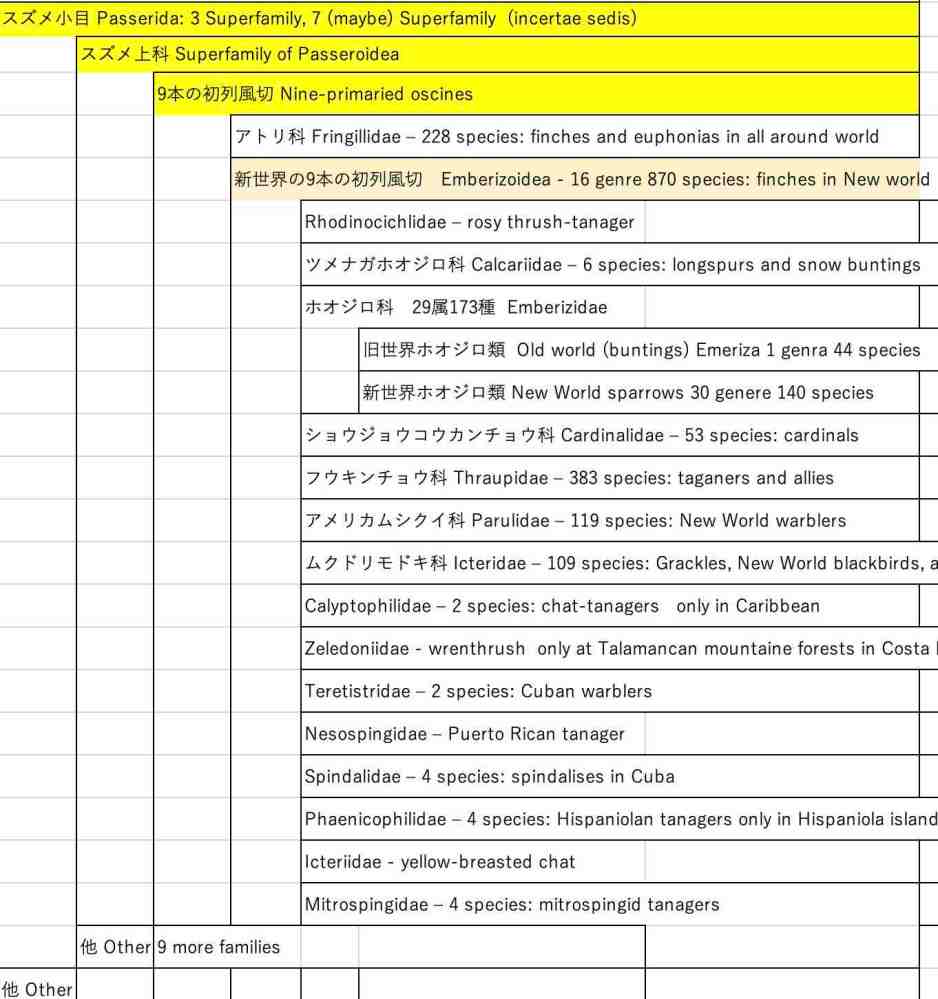
新世界のフィンチ New World Finches


新世界の9本の初列風切を持つ鳥のグループは総称してフィンチとよく言われます。そして、このグループには870種もの鳥が所属しています。The New World Nine-primaried Oscines (Emberizoidea) group is often collectively referred to as the finches. And as many as 870 species belong to this group.

Screenshot

とは言え、この辺の分類には自信がありません。専門家の間でも未だに流動的だからです。 However, I am not sure about the classification of this area. It is still in flux, even among experts.

ニシフウキンチョウのオス Western Tanager male

実際、スズメ目は全体の鳥の種の半分以上をしめていて、その中でも更にスズメ亜目、スズメ小目、スズメ上科と分類されています。そして、それぞれの見かけが非常に似ている。 In fact, the order Passeriformes comprises more than half of all bird species, which are further classified as the suborder Passeri, the infraorder Passerida, and the superfamily Passeridea. And each looks very similar.

ニシフウキンチョウのメス Western Tanager female

ともあれ、次回から、このグループの中から独断で5つの科を選んでご紹介します。 In any case, starting with the next issue, I will introduce five families from this group, selected from my own bird picture collection.

アトリ科 – 頑丈な嘴 Fringillidae – Strong Beaks


スズメ上科には以下の10の科が分類されています。 The following 10 families are classified in the superfamily Passeroidea.

Screenshot

ただ、そのほとんどが旧世界の鳥なのでスキップしますが、ここでは例外の一例としてイエスズメを紹介します。 However, since most of them are Old World birds, I will skip them, but here is an example of an exception: the House sparrow.

イエスズメはもともと旧世界の鳥でしたが、移入され、今ではほぼ全ての大陸に定住しています。多分、よく見かける鳥だとは思うのですが、そのためか、私の鳥コレクションの中にはこのショットしかありませんでした。 The House Sparrow was originally an Old World bird, but it has been introduced and is now settled on almost every continent. It is one of the most common birds, but perhaps that is why this shot was the only one in my bird collection.

さて、本題です。9本の初列風切ファミリーは更にアトリ科と新世界の9本の初列風切ファミリーに分類されています。今日はその中のアトリ科について書きます。また、「9本の初列風切」羽については以前、書きましたので、ご興味があったらそちらをご覧ください。(羽の数) Now, to the main topic: the Nine-primaried oscines family is further divided into the Fringillidae family and the Emberizoidea family. Today, I will write about the Fringillidae family. I have written about the “Nine-primaried” feathers before, so if you are interested, please refer to that article. (Number Of Feathers)

Screenshot

アトリ科の鳥は総称してフィンチと呼ばれています。特徴は小さい鳥ですが、円錐形の頑丈な嘴を持っている事です。固い木の実も噛み砕くのに最適です。 Birds of the family Fringillidae are collectively known as finches. They are characterized by their small but sturdy conical bill. It is ideal for chewing even hard nuts.

アトリ科には228種もの鳥が分類されていますが、ほとんどが旧世界のとりなので、ここでは私の鳥コレクションから5種を紹介します。 There are 228 species of birds classified in the family Fringillidae but since most of them are Old World birds, here are five species from my bird collection.

トップバッターはメキシコマシコです。この鳥も飽きるほど家の周りで見られます。 The top hitter is the House Finch. This bird can also be seen around the house to the point of boredom.

上の写真は全てメキシコマシコのオスです。春先には赤い色が更に引き立ちます。それに比べると、メスは地味です。 All of the photos above are of male House Finches. The red color is even more striking in early spring. In comparison, the female is more subdued.

そして、働き者です。巣作りの忙しい時、オスにも頑張ってもらいましょう。 And the females are hard workers. Work harder you male finch!

こちらはヒメキンヒワです。一番小さい鳥のグループに入ります。 This is a Lesser Goldfinch. It is in the smallest group of birds.

下の写真もヒメキンヒワです。頭の黒さにばらつきがあるのでヒメキンヒワと断定する事ができませんでした。見かけがとても似ているオウゴンヒワも北米に生息しているからです。でも、オウゴンヒワは黒い頭がもっとくっきりしているそうです。 The photos below are also of Lesser Goldfinches. I was unable to determine that they are also Lesser Goldfinches because of the variation in the blackness of its head. This is because a very similar-looking Goldfinch is also found in North America. However, I heard that the black head of Goldfinch is much sharper.

次に登場するのはチャバライカルのご夫婦です。 Next up is a couple of Black-headed Grosbeak.

オスもメスも共に卵を温めます。また、多くの場合、メスの鳴き声はオスの簡易バージョンなのですが、時にはフルバージョンを鳴くといわれています。きっと卵を温める際の敵を欺く作戦ではないかと言われています。 Both males and females warm their eggs. In most cases, the female’s song is a simplified version of the male’s, but sometimes it is said that she makes a full version of the male’s song. It is said that this may be a strategy to deceive enemies when laying eggs.

次はキビタイシメのご夫婦です。一度しか見た事がありません。山岳地帯やカナダに生息しているようですが、冬はアメリカ南部にも飛んでくるようです。 Next is a couple of Evening Grosbeaks. I have only seen them once. They seem to live in the mountains of the U.S. and Canada, but in winter they seem to fly to the southern United States.

それにしても、キビタイシメという日本語名はどこから来たのでしょうか。語源がわかりません。 (relevant to only for Japanese language.) Still, where did the Japanese name “kibitaishime” come from? I do not know the etymology.

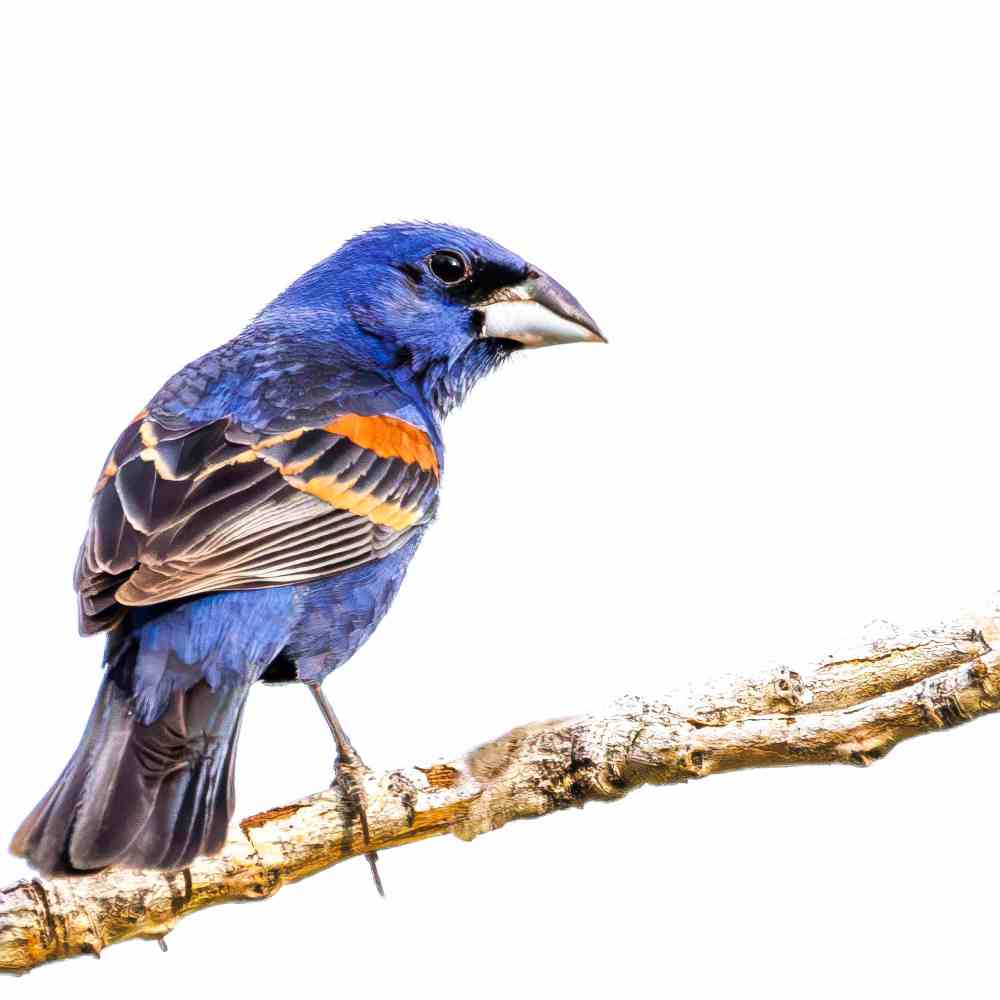
最後に紹介するのはルリイカルです。この鳥を初めて遠くに目撃した時は、自分の目を疑いました。こんなに美しい鳥がいていいの? Lastly, I would like to introduce you to the Blue Grosbeak. When I first spotted this bird at a distance, I couldn’t believe my eyes. How could such a beautiful bird exist?

日本語名の「ルリイカル」はこの鳥にピッタリです。ただの青い鳥ではないのです。瑠璃のような深い青い色の鳥なんです。 The Japanese name “Ruriikaru” which defines a specific shade of blue fits this bird perfectly. It is not just a blue bird. It is a bird with a deep blue color like lapis lazuli.

例えばキビタイシメに比べると2分の1の大きさで小さい鳥です。それでも越冬するために中南米まで飛んでいくそうです。今年も春になったら来てくれるでしょうか。 It is a small bird, one-half the size of, for example, the Evening Grosbeak. Even so, they fly to Central America to overwinter. I wonder if they will come again this spring.

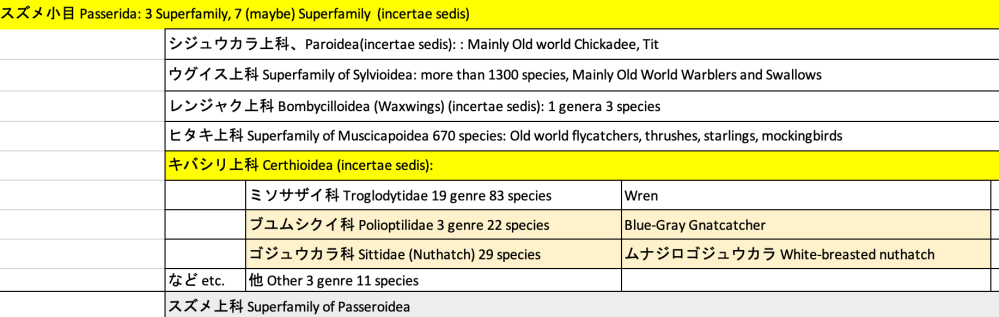
ブユムシクイとゴジュウカラ Gnatcatcher and Nuthatch


ブユムシクイとゴジュウカラは共に鳥類の中で最小の鳥のグループに入ります。 Both the Gnatcatcher and the Nuthatch are among the smallest bird groups.

体重も1オンス (30 g)と軽いので、逆さまになって気の幹を走るのが得意です。それが理由で、キバシリ(木の上を走る)という名前がつけられたんですね。 Weighing only 1 ounce (30 g), they are good at running upside down on tree trunks, which is why they were given the name “tree creeper” (tree runner)” in Japanese for the family name.

ムナジロコジュウガラ White-breasted nuthatch

この分類を始めるまで、これらの鳥の印象は上記の理由で似たような印象を持っていましたが、結構違うことがわかりました。 Before I started this classification, I had the impression that these birds were similar for the reasons mentioned above, but I found that they are quite different.

ブユムシクイの体重はムナジロゴジュウカラの3分の1しかないのに驚きです。アメリカツリスガラよりほんのわずか大きいぐらい。 It’s surprising that the weight of the Blue-Gray Gnatcatcher is only one-third that of the White-breasted Nuthatch, and only slightly larger than the Verdin.

ブユムシクイのオス Blue-Gray Gnatcatcher, male

そんな小さなブユムシクイですが、なんと、冬には南に飛んでいきます。長距離ではないけれどね。そして、暖かくなって来たらまた戻ってくるそうです。でも、風に飛ばされて北に行き過ぎてしまうことも多々あるそうです。軽いですからねー。逞しい! Although they are such small birds, they fly south in winter. Not long distances though. Then, when it gets warmer, they come back. However, they are often blown by the wind and go too far north. That’s because they are so light.  A tough bird!

ブユムシクイのメス Blue-Gray Gnatcatcher, female

私は、結構この鳥がすきです。なぜなら、こんなに小さいのにオスの顔の眉毛が太いVの字でオヤジ顔に見えてしまうからです。 I quite like this bird because, even though it is so small, the male’s unibrow forms a thick V, making it look like an old man’s face.

ブユムシクイのオス Blue-Gray Gnatcatcher, male

ムナジロゴジュウカラについてはあまり知識がありません。ただ、習性に特徴があります。 I don’t know much about the White-breasted Nuthatch, but it has some peculiar habits.

英語名のNuthatch は: Nut(木の実) + Hatch (殻を破る)= 木の実の殻を破る鳥 The English name Nuthatch is: Nut + Hatch = A bird that breaks the shells of nuts.

ムナジロゴジュウカラ White-breasted nuthatch

余分に収穫できた木の実などを木の割れ目などに押し込んで貯蔵しておく習性があります。貯蔵された木の実は貯蔵中に自然に割れるというメカニズムを知っているんですね。 They have the habit of storing surplus nuts by pushing them into cracks in trees. They know the mechanism by which stored nuts naturally crack while in storage.

ムナジロゴジュウカラ White-breasted nuthatch

鳥の生態の観察はすればするほど面白くなります。 The more you observe bird life, the more interesting it becomes.

さて、次回から鳥類最大のグループ、スズメ上科、分類表最後のグループに入って行きます。うれしい! Well, from next time we will be moving on to the largest group of birds, the passeroidea superfamily, the last group in the classification chart. I’m excited!

ヒメレンジャク Cedar Waxwing


ヒメレンジャクは私の好きな鳥の一種です。The Cedar Waxwing is one of my favorite birds.

ヒメレンジャク Cedar Waxwing

黒い覆面をしてスムーズな羽根を持ち、冠へのラインが格好いい。ロビンと同じぐらいのサイズで15cmぐらいの大きさです。 They have black masks, smooth wings, and a cool line to the crown. It is about the same size as a robin, about 15 cm.

私の分類表の中に、ついに登場してくれました。 They finally appeared in my classification table.

ピロカンサに赤い実がなる頃、たくさん集まって来ます。 During the time when the pyracantha produces red berries, they gather in large numbers.

3月のある朝、まさに旅に出ようと荷物を車に乗せたところで前庭を見ると、ピラカンサの横に植えてある白樺の木の上にヒメレンジャクがとまっていました。 One morning in March, just as we were loading our luggage into the car for the trip, we looked out into the front yard and saw Cedar Waxwings perched on birch trees planted next to pyracantha trees.

しかも、大軍でした。 And it was a large force.

時間がなかったので、数枚撮っただけで、泣く泣く出発しました。きっとこんな機会がまたあるだろうと思おもいながら。でも、その後そんなチャンスは、まだ訪れて来てくれていません。 We had no time, so we took only a few pictures and departed in tears. I thought that there would be another opportunity like this. After that, however, such an opportunity has not come.

多分、これが2024年最後のポストになります。みなさん、良いお年をお迎えください! This will probably be my last post for 2024. I wish you all a happy new year! 

ウグイス上科 Sylvioidea – Old World Warblers & Swallows


スズメ小目の中には3つの上科があります。スズメ上科、ヒタキ上科、そしてウグイス上科です。そして、その他の7つの科は、多分、上科とされているものです。 There are three superfamilies within the Lesser Sparrow Family. They are the sparrow superfamily, the flycatcher superfamily, and the warbler superfamily. And the other seven families are probably (undefined) considered superfamilies.

Screenshot

実のところ、スズメ小目の分類はまだ進行形で、今後も変化する可能性があります。また、どのグループにも属していない鳥たちも存在します。帰る家がない鳥たちのようで、かわいそうな感じがします。(当然、彼らにとってはどうでもいいことなんですが。) As a matter of fact, the classification of the Lesser Sparrow Order is still a work in progress and is likely to change in the future. There are also birds that do not belong to any group. I feel sorry for them, as they seem to be birds that have no home to go back to. (Of course, it doesn’t matter to them.)

話をウグイス上科にもどします。 Let’s return to the Uguisuue family.

Screenshot

この科には1300種もの鳥が属していますが、そのほとんどは旧世界に住んでいます。だから私の手元にはほとんど写真がありません。でも、その中でも、ツバメ科の中の3羽の写真がありました。 There are 1300 species of birds belonging to this family, most of which live in the Old World. So I have very few pictures of them. But I did find pictures of three of them in the swallow family.

ミドリツバメの子供。Tree Swallow: maybe a juvenile
日本語名がみつかりません。Violet-green Swallow
スナゴイツバメ Bank Swallow

ところで、話は少しずれますが、実は、この分類を始めるまで、アマツバメはツバメの仲間だと思っていました。その風貌から勘違いしていました。私の分類表の中でも新鳥類の一番初めに来ている鳥の仲間であることに、今、気がつきました。 By the way, this is a bit off topic, but I actually thought that the swift was a member of the swallow family until I started this classification. I was mistaken because of its appearance. But I just realized that it is one of a group of birds that comes at the very beginning of Neoaves in my taxonomy list.

アップデートしました。Updated.

今更ですが、ここに追記しておきます。アマツバメは超高速で飛ぶことができる鳥です。並行飛行では、ハヤブサより速いとされています。4本の足指が全て前を向いているユニークな鳥ですが、そのため、木の枝に捕まることはできません。 It’s a little late to add this, but I’ll add it here. The swift is a bird that can fly at very high speeds. In parallel flight, it is said to be faster than a falcon; it is a unique bird with all four toes pointing forward, which makes it incapable of perching on a tree branch.

岸壁の隙間の中から飛び出して来たばかりのハリオアマツバメ。 White-throated needletail swift just popped out from inside a crevice in the quay.

黄色いツリスガラ Auriparus – Yellow Penduline Tit


ツリスガラの名前は、彼らの巣作り方からきています。巣を吊り下げて、下から巣の中に入るような形にしてあるのが特徴です。 The name of Penduline Tit comes from their nesting method. They are unique in that their nests are suspended so that they can enter the nest from below.

ほとんどが旧大陸に住んでいますが、一種だけアメリカ大陸に住んでいます。そして、ラッキーなことに、その一種は、私たちが住んでいる地域に住んでいるんです。 Most of them live in the Old Continent, but only one species lives in the Americas. And lucky for us, that one species lives in the area where we live.

しかも、虫取り作業が好きな彼らは裏庭に頻繁にやって来て、丁寧に無料報酬で作業をしていってくれます。ありがたいことです。 Moreover, they like to work on insects, and they frequently come to our backyard and politely do the work for free. We are grateful for it.

彼らの名前は、アメリカツリスガラと言います。過去、私のブログにも頻繁に登場してくれました。 Their name is Verdin. They have appeared frequently on my blog in the past.

アメリカツリスガラの巣作り、その2 – Verdin Nest Making (Part 2)

虫取りサービス – Bug Catching Service

一等賞の虫取りサービス – Bug Catching Service Winner

10cmぐらいのすばしっこい鳥で、好物の小さい虫や蜘蛛を捕まえるためなら、木の枝に逆さまにぶら下がることなど、へっちゃらです。 It is a swift and restless bird, about 10 cm long, and it is not afraid to hang upside down from a tree branch to catch small insects and spiders, which it likes to eat.

最近は、他の鳥に気を取られて撮ってあげていないので、来年春が近づいて来たらたくさん撮ってあげましょう。 I haven’t taken many pictures of them lately because I’ve been distracted by other birds, so next year when spring approaches, I’ll take more pictures of them.

シジュウカラ科 Paridae – Chickadee & Titmice


シジュウカラ科には隣近所でよく見かける鳥たちが分類されています。名前は知らなくてもよく見かける鳥たちですよね。 Paroidae classifies birds that are often seen in our neighborhoods. Even if you don’t know their names, you see them all the time.

朝のご飯を咥えているクロイロコガラ Chestnut-backed Chickadee with breakfast in his mouth.
ハイエボシガラ Oak Titmouse

そして、このシジュウカラ科が私の鳥分類表のどこに位置するかというと、こちらです。右下。 And here is where this family of Paridae is located on my bird taxonomy list. See at the bottom right.

Screenshot

ついに階層の奥深くまでやって来ました。字が小さくて見にくいかもしれませんね。また、分類名と使われ方もわかりにくかったので、ここで整理しておきます。 We have finally come deep into the hierarchy. It may be hard to see because the letters are so small. It was also difficult to understand the classification names and how they are used, so I’ll sort it out here.

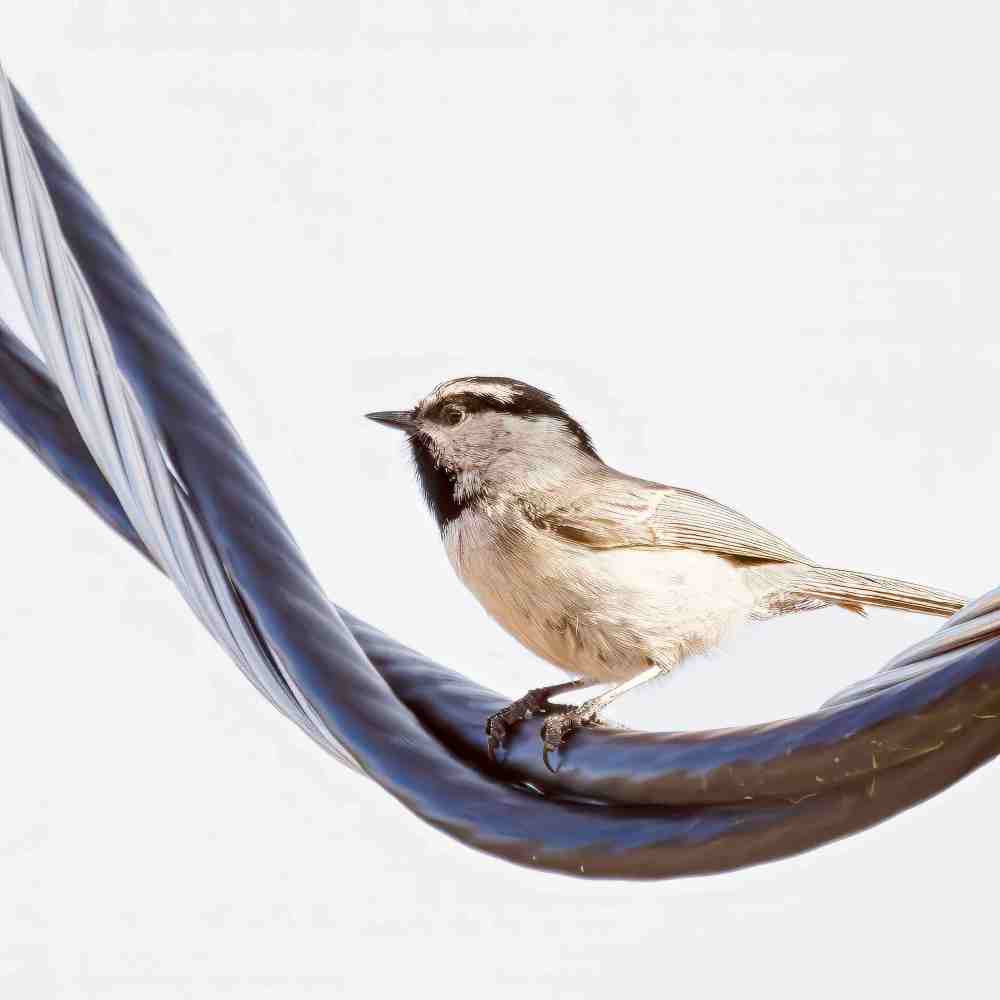
マミジロコガラを「リンネ式階層分類体系」を元に書き換えると以下のようになります。 The following is a rewriting of Mountain Chickadee based on the “Linnaean taxonomy”.

ドメイン真核生物DomainEukaryota
動物界KingdomAnimalia
脊索(せきさく)動物PhylumChordata
亜門脊椎動物Sub phylumVertebrata
鳥類ClassAves
下綱新顎類(しんがくるい)infra classNeognathae
クレード新鳥類CladeNeoaves
クレード陸の鳥類*CladeTelluraves
クレード真ハヤブサ形目CladeEufalconimorphae
スズメ目OrderPasseriformes
亜目スズメ亜目SuborderPasseri
小目スズメ小目ParvorderPasserida
上科シジュウカラ上科Super familyPasseridea
シジュウカラ科FamilyParidae
コガラ属GenusPoecile
マミジロコガラSpeciesMountain chickadee
* 「陸の動物」の日本語訳はなかったので勝手に訳しました。
マミジロコガラ Mountain Chickadee

ここで注目したいのは、突然、「クレード」という言葉が出て来たことです。リンネの分類学では使われていません。これは分岐分類学が使う用語です。この新しい分岐分類学に関しては賛否両論あるようですが、それを話し始めると鳥の分類に戻れなくなるので書きません。ご興味のある方はこちらをご覧ください。https://cladistics.org/cladistics/ (英語なので、翻訳ツールなどを使ってご覧ください。) It is important to note here that the word “clade” has suddenly appeared. It is not used in Linnaean taxonomy. This is the term used by Cladistics taxonomy. There seems to be some controversy about this new Cladistics taxonomy, but I won’t write about it because if I start talking about it, I won’t be able to go back to bird taxonomy. If you are interested, please see here: https://cladistics.org/cladistics/

私の意見は、分類方法を’勉強することに興味があるわけではないので、分類学でも、分岐学でもどちらでもいいです。一羽の鳥を見たら名前と特徴がわかれば十分なんですね。ただ、世界中に1万種もの鳥がいるので、私の写真も少しは整理整頓させておきたいと思っているだけです。だから、まだ見たことのない鳥、興味のない鳥、今後も見ることができない鳥はさっさと諦めて表から外しています。 My opinion is that I am not interested in ‘studying’ classification methods, so either Linnaean or Cladistics is fine. If I see one bird, it is enough for me to know its name and characteristics. I just want to keep my photos a little more organized, since there are 10,000 species of birds in the world. So, I quickly give up and remove from the table those birds that I have not yet seen, have no interest in, or probably won’t see in the future.

私の分類表作りはこれからもしばらく続きますが、その過程の中ですでに多くのことを学びました。でも、それ以上に得たものは、大袈裟な表現になりますが、私の心に平安をもたらしてくれました。 My work on the classification table will continue for some time to come, and I have already learned a great deal in the process. But what I have gained even more, and this may be an exaggeration, is peace of mind.

例えば、こんな状況を想像してみてください。無数の鳥たちが頭の中をいつも規則なく飛び交っている状況です。それが、鳥たちの家を作ってあげたことで、少しずつ家に戻っていくわけです。最終的には家の外にいる鳥はいなくなる。時々鳥の名前を呼ぶと家から出て来てご挨拶してくれる。そんな平安さでしょうか。 For example, imagine this situation. This is a situation where countless birds are always flying around in your head randomly. That is why you have built homes for the birds, and they gradually return to their homes. Eventually there will be no birds outside the houses. Sometimes when you call a bird’s name, it will come out of the house and greet you. It is that kind of peacefulness. Isn’t it great? 

「頭に冠をつけているエボシガラ君、出て来てください。」 ”Come out, Mr. Titmouse, who wears the crown on your head.”

「はい、今すぐ。ぴー、ぴいぴいぴ」 ”Yes, coming out. peeeee, pee, pee, pee”

ハイイロエボシガラ Oak Titmouse

ハヤブサ Peregrine Falcon


鳥の分類表作り、まだまだ続きます。 Making a bird classification chart, continuing.

Excel シートを使って表を作っているので、行の番号を見るとおおよその進行状況がわかります。 The table is made using an Excel sheet, so the row numbers give an approximate progression.

ゲラ・ブッポウソウ類までで分類表の半分が終了したことになります。(2-87行まで)そして、今日からこの分類表の後半となります。(88-162行)  Half of the taxonomic table has been completed up to the clade Picocoraciae (from to lines 2-87). And today we will start the second half of this table. (lines 88-162)

さて、ハヤブサ目ですが、以下の表のようにシンプルにまとめました。 Now, as for the order Falconiformes, I have simplified them as shown in the table below.

このグループの鳥たちは猛禽類です。そのため、かつてはタカ目に属していましたが、2008年以降、DNA分析の結果、スズメ目などに近しいことが判明し、真ハヤブサ形類の仲間になったということです。 The birds in this group are birds of prey. Therefore, they used to belong to the order Hawks, but since 2008, DNA analysis has shown that they are closer to sparrows and other birds of the order, and they are now members of the Eufalconimorphae, true falconiforms.

ただ、生物学の研究も他の分野と同じように複雑怪奇で、さまざまな意見があり、分類、系統表は今後もさらに進化していくことでしょう。だから私の作っている表は、あくまでも私個人の興味に基づいて抽出したものだけが収められている偏った表になっています。 However, the study of biology, like any other field, is complex and bizarre, and there are many different opinions, and classification and phylogenetic tables will continue to evolve further in the future. Therefore, the table I am making is a biased table that contains only extracts based on my personal interests.

さて、私のファルコンの写真たちです。 Now, here are my Falcon photos.

上の3番目の写真ですが、アカオノスリとハヤブサの戦闘シーンです。ハヤブサの猛攻撃にアカオノスリが空から落ちて来るシーンも目撃しました。 The third photo above shows a battle scene between a Red-tailed Hawk and a Peregrine Falcon. We also witnessed a scene where a red-tailed hawk fell from the sky under the onslaught of the falcons.

でも、あまりにも長い戦いだったので、結果を待たずに引き上げました。このハヤブサですが、本当にハヤブサかどうか自信がないです。顔はハヤブサっぽいですが。ソウゲンハヤブサかもしれません。どっちだと思いますか? But it was too long a fight, so we walked away without waiting for the results. By the way, although I said it is a Peregrine Falcon, I am not so sure about this identification. Although the face looks like a Peregrine, it could be a Prairie Falcon instead. Which do you think it is?

いずれにしろ、もっと画質のいいハヤブサの写真を撮る必要がありますね。 In any case, I need to take better quality Peregrine Falcon photos.

カワセミとキツツキ Kingfisher And Woodpecker


鳥の分類続きます。 Bird classification continues.

今日は黄色いハイライトの鳥たちについてです。 Today I will write about the birds with yellow highlights.

カワセミはブッポウソウという目の中に分類されている動物食の鳥です。全体的に鮮やかな色の鳥たちです。水辺に生息し、水面に急降下して魚類を捕食します。その他、虫や爬虫類も食べます。 The Kingfisher is a zoophagous (flesh eating) bird classified in the order Coraciformes. Overall, these birds are brightly colored. They live near water and prey on fish by swooping down to the surface of the water. They also feed on insects and reptiles.

数回カワセミを見かけましたが、写真に収められたのは、この2枚だけです。アメリカヤマセミです。 I saw Kingfishers several times, but these are the only two I was able to photograph. They are Belted Kingfishers.

この地に引っ越して来たばかりの頃、鳥の会の人たちと公園を歩いていた時に見つけました。鳥の会の人たちは高性能の双眼鏡を持っているので、遠いところの鳥も発見し教えてくれます。この時も興奮して早速撮りましたが、豆粒のようなイメージだったので忘れていました。 When we first moved here, I found this bird when I was walking in a park with a group of birders. The bird club members have high-performance binoculars, so they can spot and tell us about birds at a distance. I was so excited at this time that I immediately took a picture of it, but I had forgotten about it because the image was as small as a pea.

カワセミは気合を入れて撮ろうとしないと撮れません。今度は川辺でまさに魚を捕獲したばかりの時とかをキッチリと撮りたいです。 I can’t take pictures of Kingfishers unless I put a lot of effort into it. Next time, I would like to take a picture of a Kingfisher when it has just caught a fish by the riverside.

次にご紹介するのはキツツキです。 The next bird is the Woodpecker.

今回、キツツキ科を調べていたら、無数の種が含まれている事を知り驚きました。私の鳥分類表もさらに巨大化してきたので、ここでは私が撮影できたキツツキのみをリストします。 In researching the Woodpecker family this time, I was surprised to learn that it includes a myriad of species. Here I will list only the Woodpeckers I was able to photograph because my bird taxonomy list has grown even larger.

ちなみに、ゲラとかブッポウソウという分類名も鳥の観察歴が短い私には聞いたことがなく、不思議な名前でした。でも、日本語名としては普通に使われているんだと学習しました。 Incidentally, I had never heard of the taxonomical names “gera” and “buppoosoo” in Japanese language, which were also strange to me, having only a short history of bird observation. But I learned that they are commonly used as Japanese names.

以下、参考として、これらの名前の由来を説明します。 The following is an explanation of the origin of these names for reference.

「ゲラ」は「ケラ」から来ていて、「ケラ」とは木の中に住む虫のことです。江戸時代前から使われていたようです。まさにキツツキのことです。 “Gera” comes from “Kera”, and “Kera” is an insect that lives in trees. It has been used since before the Edo period. It is exactly what a Woodpecker is.

また、「ブッポウソウ」の名前の由来 は勘違いが原因だと言えます。以下、由来の要約です。 The origin of the name “Buppoosoo” can be attributed to a misunderstanding. Here is a summary of the origin

ブッポウソウは日本にやって来る渡り鳥で、5-6月ごろ、たった3週間ほどしか滞在しません。 また、コノハズクは5-6月ごろしか鳴かないフクロウです。The boubou is a migratory bird that comes to Japan and stays for only about three weeks around May and June. The Oriental Scops Owl is also an Owl that only hoots around May and June.

昔の人たちは、この2種の鳥たちを混同し、まだ見た事のない鳥が、まるで「ぶっ・ぽう・そう」と鳴いているようだと思いました。そこでこの幻の鳥をブッポウソウ(仏法僧)と名付けました。 People in the past confused these two species of birds and thought that the bird, which they had not yet seen, sounded as if it were calling “Buh-poh-soh”. Therefore, they named this phantom bird “Buppoosoo” (Buddha’s Prayer).

その後、ラジオが普及してきた1935年頃、この鳥の鳴き声をラジオで放送したところ、反響があり、鳴き声の主はコノハズクであったことが判明しました。でも、すでに定着していた2種の鳥の名前を変えるのは大変なので、そのままの名前が残っているということです。  Later, around 1935, when radio became popular, the bird’s call was broadcast on the radio, and the response from listeners was so strong that it was discovered that the bird call was that of an Oriental Scops Owl. But it would be difficult to change the names of two birds that were already well-established, so the names have remained as they are.

フクロウ目 Owls


鳥の分類、続いてます。 Bird classification continues.

フクロウは大きく2種類に分かれます。メンフクロウ科とフクロウ科です。 Owls are divided into two main families. The family Tytonidae (Barn-owls) and the family Strigidae (True owls).

メンフクロウ科の中にはメンフクロウしかいません。は名前が示すように、お面をつけているような顔が特徴です。 The Barn owl is the only member of the barn owl family. It is characterized by a masked face.

メンフクロウは世界中に分布していますが、私は一度も目撃したことがありません。英語の名前の通り、納屋とか廃屋などでも見られるそうです。この辺にもそんな場所がありそうなので鳥の会の人たちに聞いてみます。 Barn owls are distributed all over the world, but I have never seen one. As the name suggests, they can be found in barns and abandoned buildings. I will ask the birders about such places around here.

フクロウ科には無数のフクロウが属しています。列挙しきれないので、私のリストには目撃したもののみを入れました。 Countless owls belong to the owl family. Since it is impossible to enumerate them all, I have included only those that I have seen in my list.

フクロウ科の1種目はアナホリフクロウは いくつかの点でユニークなフクロウです。 One member of the owl family is the Burrowing owl which is unique in several ways.

  • 日中でも動き回る。 They move around even during the day.
  • 飛べるけど、地上を走り回っている時間の方が長い。だから足が長いのね。 They can fly, but they spend more time running around on the ground. That’s why they have long legs.
  • 地面に穴を掘って住む。 They live in burrows in the ground.

眉毛が白くておじいさんみたいな顔してますね。ジャシュアツリーの上に停まっていました。 In the picture above, he looks like an old man with white eyebrows. It was perched on top of a Joshua tree.

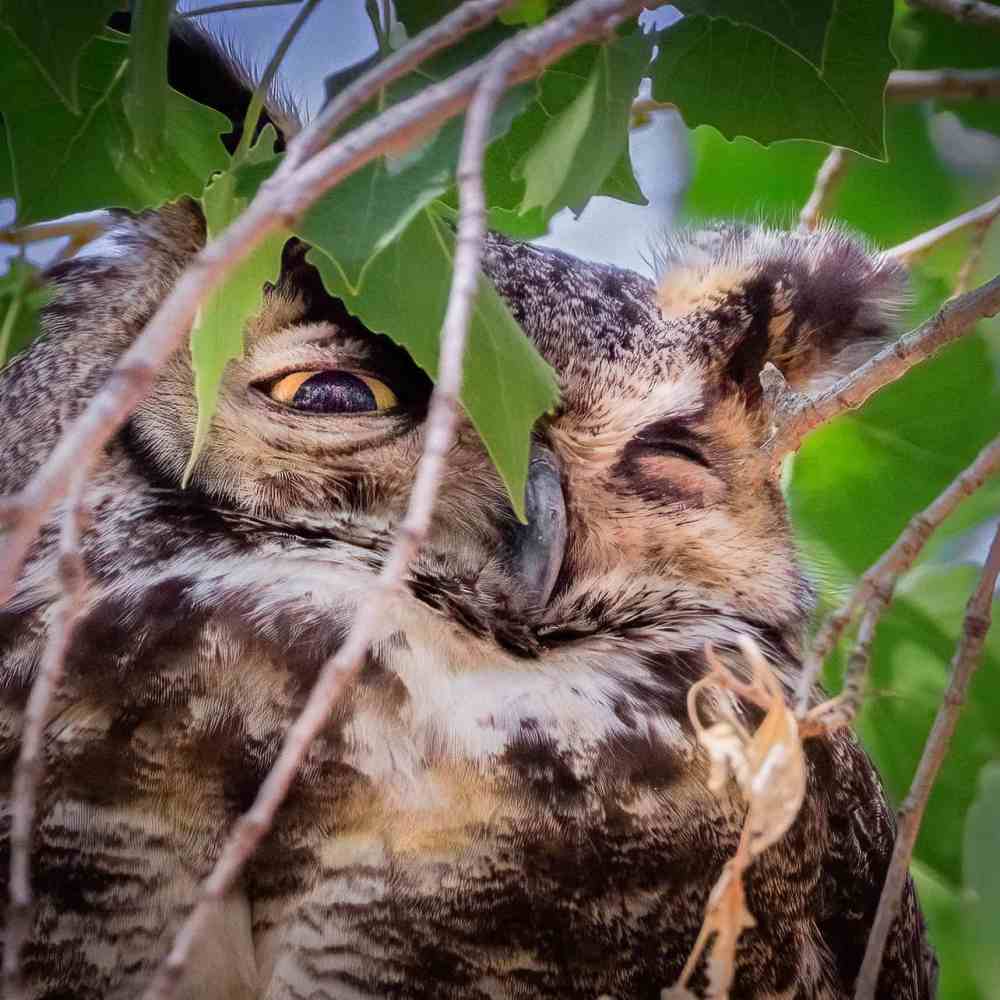
アメリカワシミミズクは私にとっては一番馴染み深いフクロウです。 The Great Horned Owl is the owl most familiar to me.

ここは「フクロウの森」です。勝手に名付けました。そこに入ってみると、確かにフクロウが生息するにはもってこいの場所でした。 This is “Owl Forest”. I took the liberty of naming it. When I entered there, I found that it was indeed a perfect place for owls to inhabit.

音を立てずに辺りを見渡すと、コットンツリーの上の方、トトロのような物体を発見しました。高鳴る気持ちを抑えて静かにシャッターを切りました。 I looked around without making a sound and spotted a Totoro-like object at the top of the Cotton Tree. I suppressed my rising emotions and quietly clicked the shutter.

鬱蒼として暗い中、しばらくすると崖の上の方の棚に巣があり、それを覆い隠すようにコットンツリーの枝が伸びていることがわかりました。更に私たちの目が暗さに慣れてくると、2羽、3羽、4羽と合計5羽見つけることができました。 It was dense and dark, but after a while we found a nest on a ledge at the top of the cliff, with Cottonwood tree branches growing up to cover it. As our eyes further adjusted to the darkness, we found a total of one, two, three, four, five birds.

ここはワシミミズクの家族が住んでいるところだったんですね。そして、ヒナが3羽巣離れをしたばかりだったのかもしれません。 So this was where a family of Great horned owls lived. Maybe three chicks had just left the nest then.

私たちの家にも時々訪れてくれます。 They visit our house from time to time.

昼も夜もウサギが飛び回っている環境です。彼らにとってはよりどりみどり、スーパーマーケットの状態です。下の写真はうさぎをゲットした直後、それを引きずりながら石の影に隠れようとしているところです。 This is an environment where rabbits are hopping around day and night. It is a supermarket situation for them. In the photo below, just after getting a rabbit, he is trying to hide behind a stone, dragging it behind it.

お食事中、失礼しました。 Excuse me for interrupting your meal time.

最後に紹介するのはニシアメリカオオコノハズクです。 Lastly, I would like to introduce the Western Screech Owl.

夜中、大きな木が立ち並ぶ川沿いの森の中、鳥の会の人たちと時折聞こえる鳴き声を頼りに歩き回りました。 In the middle of the night, in the forest along the river lined with large trees, I walked around with the bird club members, relying on the occasional hoo, hoo.

シャッターチャンスは3回ありましたが、夜中の撮影は非常に難しいので、これが最後に撮れたベストショットです。ネズミを捕獲したばかりだったので、ラッキーでした。 I had three opportunities, but this was the last best shot I could get taking pictures in the middle of the night. I was lucky because it had just captured a rat.

名前が示すように、日中は木の葉のようにカモフラージュしてジッとしているそうです。 As the Japanese name suggests, they are said to camouflage and stay still during the day like leaves on a tree.

鳥の分類表 Bird Classification Table


前回のブログで水禽類を紹介しました。これからいよいよ待ちに待った陸の鳥の分類に入ります。 In my last blog I introduced water fowl. I will now finally begin the long awaited classification of land birds.

その前に、復習も兼ねて全体像を見てみましょう。以下の表が今現在の分類です。小さすぎて、読めないですかね。Excelシートを使っているので折りたたんで小さくしたんですが。全体像は分かっていただけると思います。 Before I begin, let’s do a review and overview. The following table is my current classification. Is it too small to read? I tried to make it smaller by using Excel’s collapse feature. In any case, I hope you get the overall picture.

ここで一番注目していただきたいところは、表の一番下の列のルリノジコ属です。ここまで掘り下げるのが目標です。 The most noteworthy part here is the genus Passerina in the bottom row of the table. The goal is to dig down till this layer.

この属には、つい最近追いかけていたムネアカルリノジコが入っているんです。 This genus includes the Lazuli Bunting, which I have been chasing just recently.

ムネアカルリノジコ Lazuli Bunting

しかも、見てみたいゴシキノジコも入っている! And it also includes Painted Bunting that I would like to see!

ゴシキノジコ:コーネルラボのサイトのスクリーンショット。 Screenshot from Cornell Lab website.

ということで、これからも陸の鳥類の中、深い階層を潜り抜けていかなければなりません。 旅は長いです。 So I must continue to dive through the deep hierarchy among land birds. The journey is long.

警告!うっそー! Warning! Oh, no!!!

突然、私のコンピュータの画面上に警告のポップアップが表示されました。HDの残りの許容量が30GBを切っていたんですね。マズイです。これでは写真やビデオの編集ができません。大至急データを外付けHDに移動して整理する必要があります。 Suddenly, a warning pop-up appeared on my computer screen: the remaining allowance on my HD was less than 30 GB. No way! This means I cannot edit my photos and videos. I need to move and organize my data to an external HD ASAP.

ルリノジコ Blue Bunting

やれやれ・・・ Oh dear…

面倒臭い作業を楽しくする方法はないものでしょうか。しばらくお休みとなります。 Is there any way to make a tedious task enjoyable? I will be absent for a while.