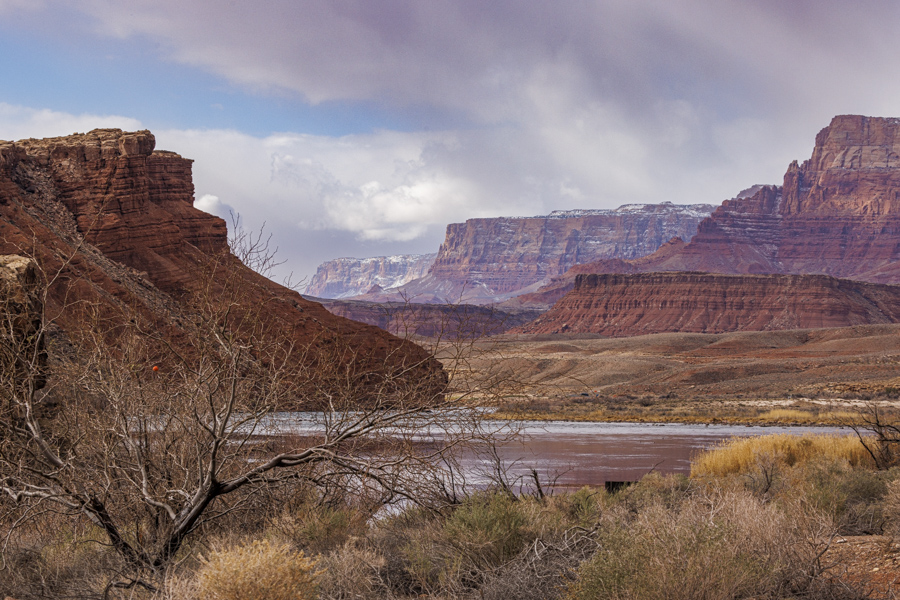
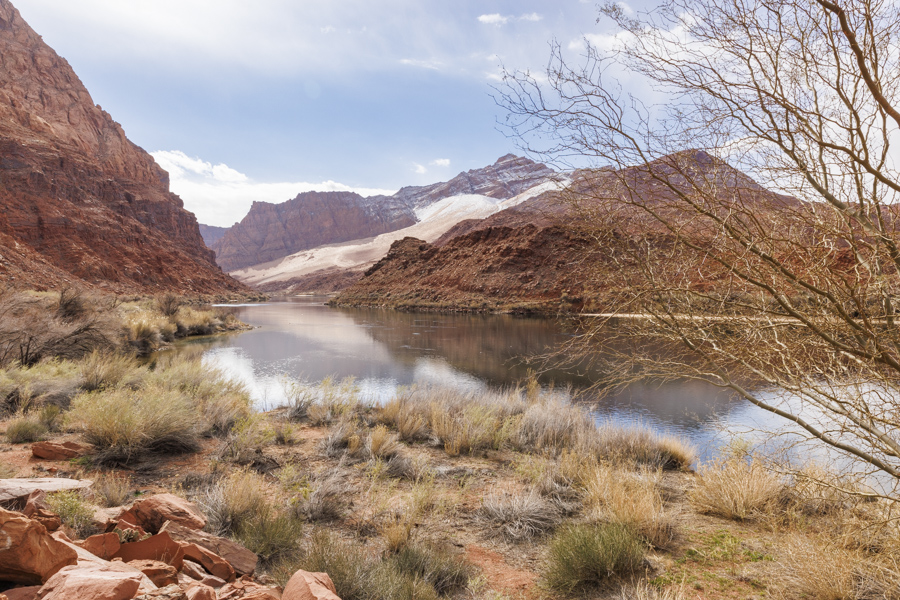
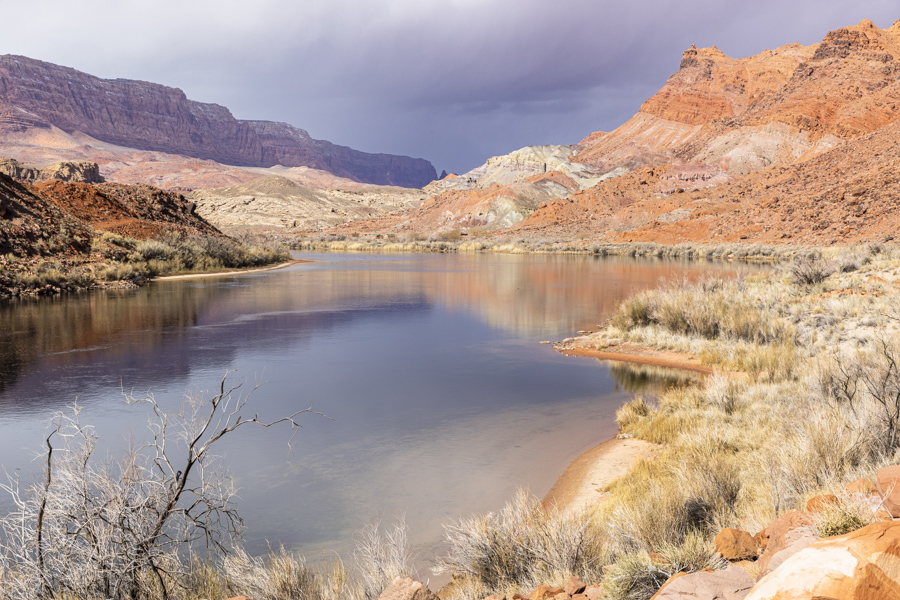
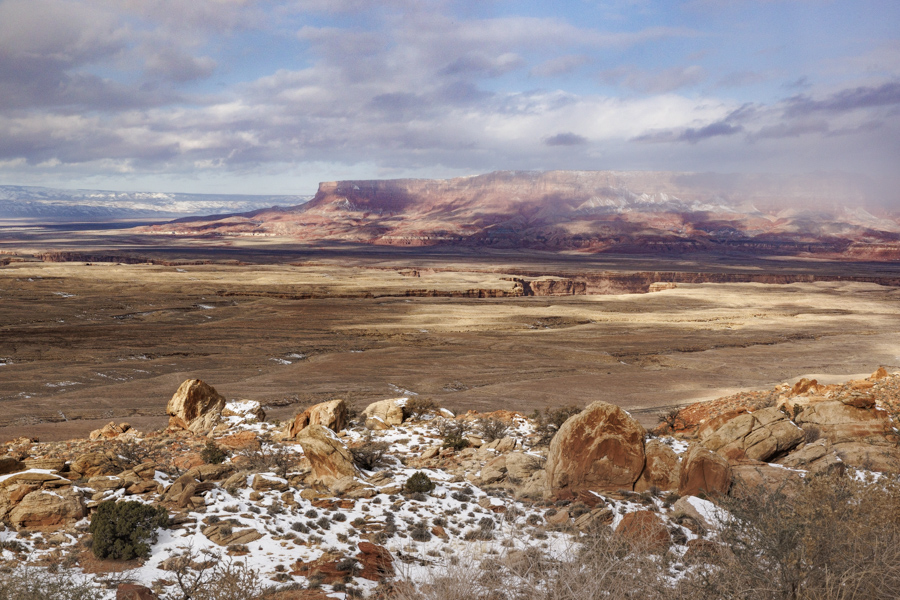
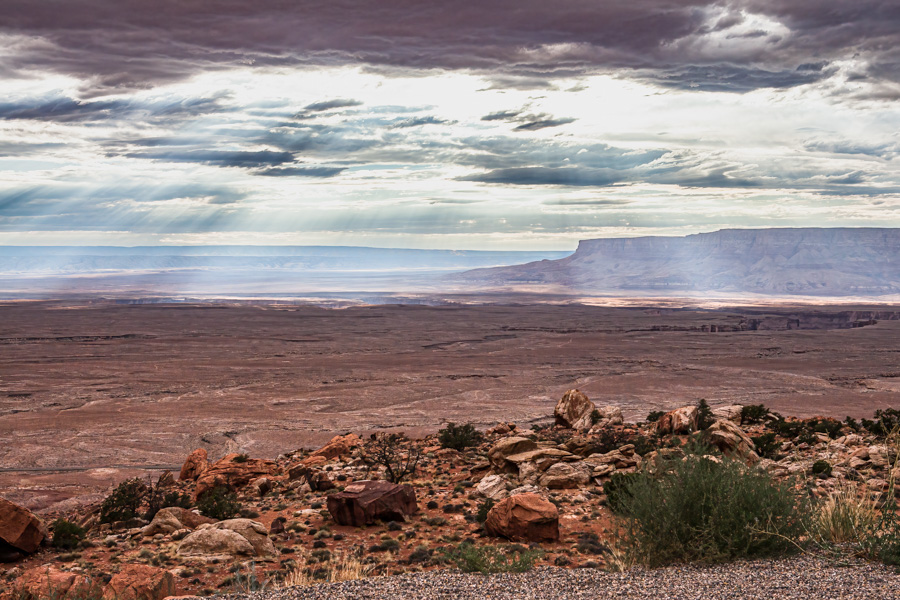
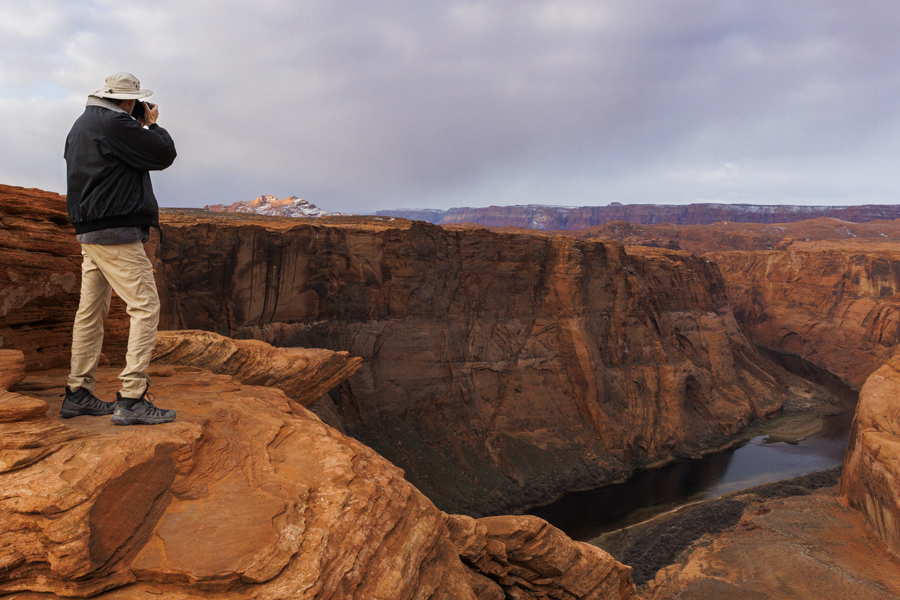
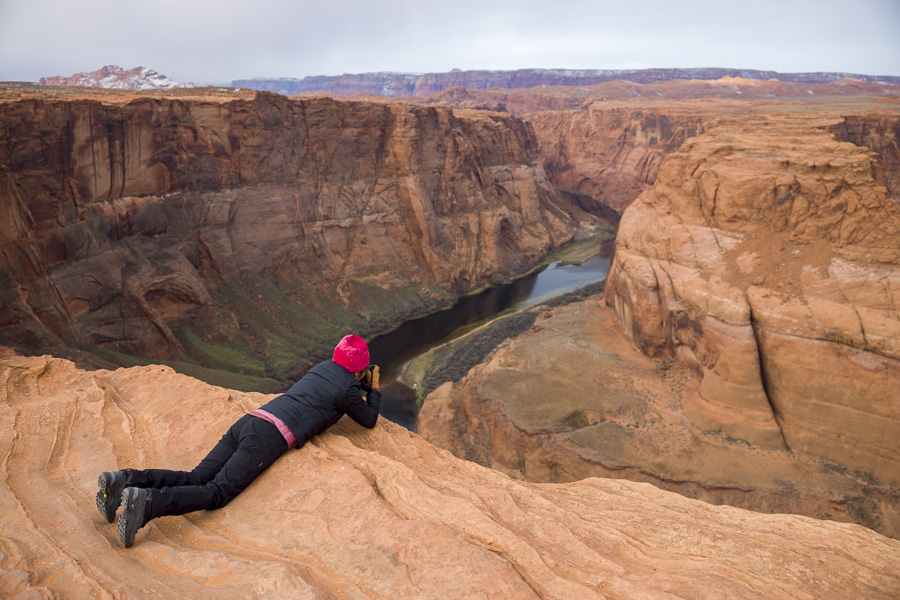
ペイジという町はアンテロープキャニオンがある所として有名です。私たちも10年前に訪れています。 The small town of Page is well known because of Antelope Canyon. We visited there 10 years ago.
遠くにナバホ山が見えます。 You can see Navajo mountain in the background.
手前はパウエル湖のはずですが、細い線のような川しか見えません。 Lake Powell is supposed to be there but we could see it only as a thin line.
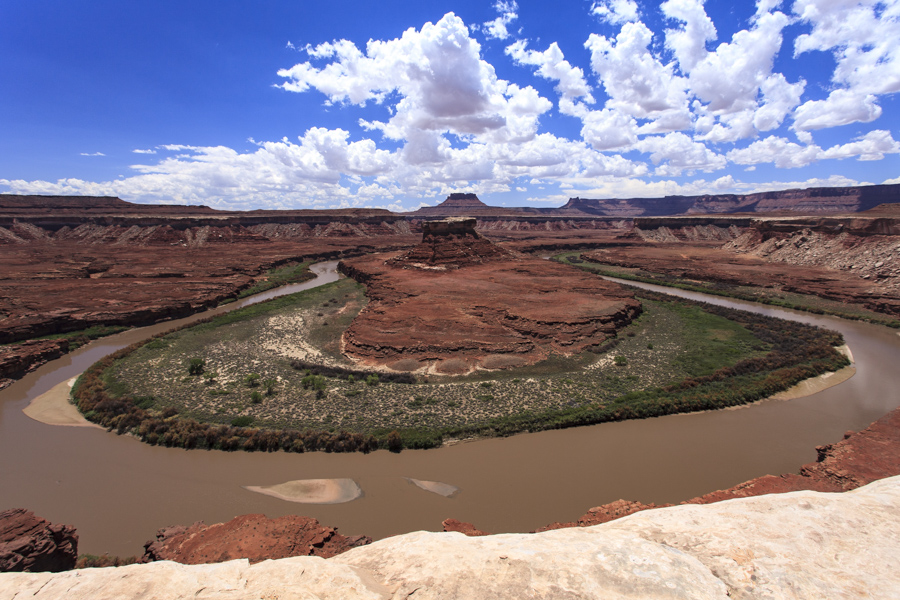
以下の写真は10年前、7月に訪れた時のショットです。ナバホ山が右に見えるので、角度は違いますが、ほぼ同じ場所から撮りました。水位の違いはかなり驚きです。 I took the picture below 10 years ago. You can see the Navajo mountain on the right side, so it should be about the same location. That’s rather shocking to see how different it is.
10年前には湖の中にポツリとあったローン ロックの周りにも、水が全くありませんでした。 The Lone Rock was in the water 10 years ago, but it’s standing on the ground now. No water was around it.
気を取り直し、水のある場所を探し求めていたらちょうど日没の時間がきていました。赤い低木がサンゴのように見えないこともないです。かつては、この辺りも水中だったはずですから。 We set aside our disappointment, and looked for a place where we can capture water. It was already about the time of sunset. I thought some foreground items looked like they were under water. Of course they weren’t, but the red bush looks like coral. The entire area was indeed under water not so long ago.
貝殻も干上がって、そこかしこに発見できました。 We could find dried up shells here and there as well.
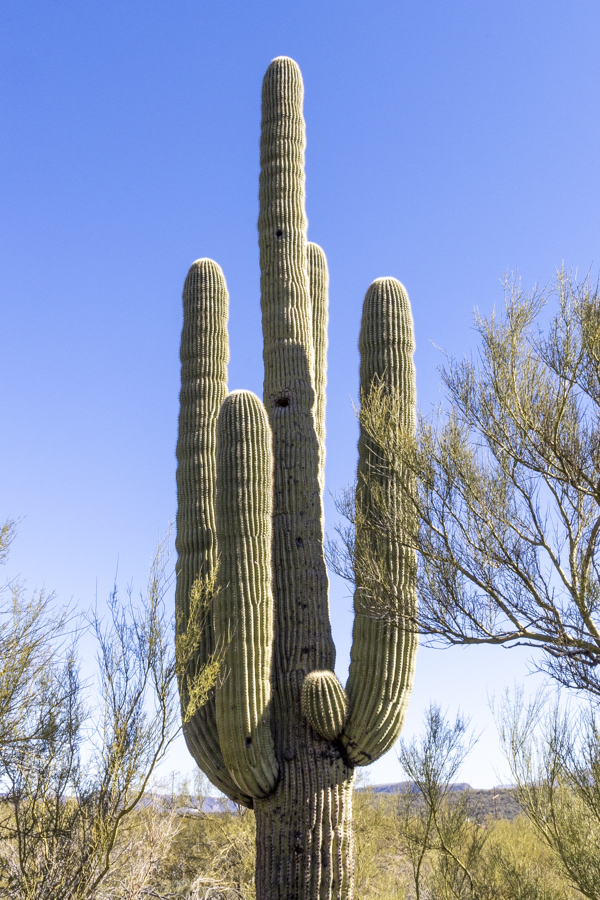
日本語名にするとサグワロと発音されていますが、英語の発音は「ソワロ」に近いです。 “Saguaro” is pronounced as either [sə-gwär′ō], or [sa-wär′ō].
アリゾナ州の南部、ソノラ砂漠地帯では高速道路沿いでもサグワロというカクタスがボコボコと生息しています。 At the southern part of Arizona, the Sonoran desert, we can see Saguaro cactus everywhere even at the side of the highway.
サグワロはソノラ砂漠地帯でしか生息しません。隣のモハビ砂漠ではやはりサボテンのジャシュアツリーが生息しているんですが、両者は共存することはなく、生息地がクッキリと分かれています。きっと環境に深く関連しているのでしょう。ちなみに、私たちの住んでいるユタ州、セイントジョージではどちらも生息していません。 Saguaro live only in the Sonoran desert. Joshua trees live in the Mojave desert right next to the Sonoran desert. They are so close to each other but they don’t co-exist in either area. I assume it’s environmental related reasons separating them. Incidentally we have neither plants in my town, St. George, UT although it touches the northern tip of the Mojave desert.
でも、走行中にほんの小さな範囲で両方が恒存している場所を見つけましたが、残念なことに証拠写真を撮りそびれました。今度また行く機会があったら絶対に証拠写真を撮ります。 But, it was very interesting that we saw both Saguaro and Joshua tree living together for only a short distance while we were driving on the highway. Unfortunately, I didn’t have a chance to take a picture to prove it.
サグワラは成長後50年経ってから、初めて花を咲かせ、その後、1年に一度の開花を繰り返し、200年ぐらい生きるそうです。カクタスなので木ではありませんが、周りに木がないので、遠くから見ると木がボコボコ生えているように見えないこともないです。ちなみに、高さは12メートル以上にも達するそうです。 Saguaro cactus live about 200 years, but they don’t bloom until after the first 50 years of their lives. At that point, they bloom once a year every year. Although its height can be 40 feet, but it’s not a tree. No trees can live that tall around there, Saguaro looks like a tree from far away.
数種類の鳥が穴を開けて住み着いています。 You will see holes in some of them, and birds are the ones to be blamed for it. They make a hole and actually live in there.
先週末から4日間、アリゾナ州フィネックスの南部に行ってきました。そこで見かけた光景でした。 This is what we saw during our trip south to Phoenix, Arizona over the past 4 days.
ついにアラスカを去る日が来ました。The last day at Alaska finally came.
アリエスカホテルの裏山に登ると、遠く氷河が時折見えましたが、ほとんど雲に隠れていました。 雨か曇りが続いた旅でした。We went up the hill behind the Alyeska Resort hotel. Glaciers were occasionally visible through the clouds. It was either rainy or cloudy throughout the entire trip.
ついに青い空を見ずに去っていくのかなと思ったら、アリエスカからアンカレッジへのバスの中から青空を見つけました。 I thought we would leave Alaska without seeing blue sky, but I found a bit through the bus window on the way from Alyeska to Anchorage air port.
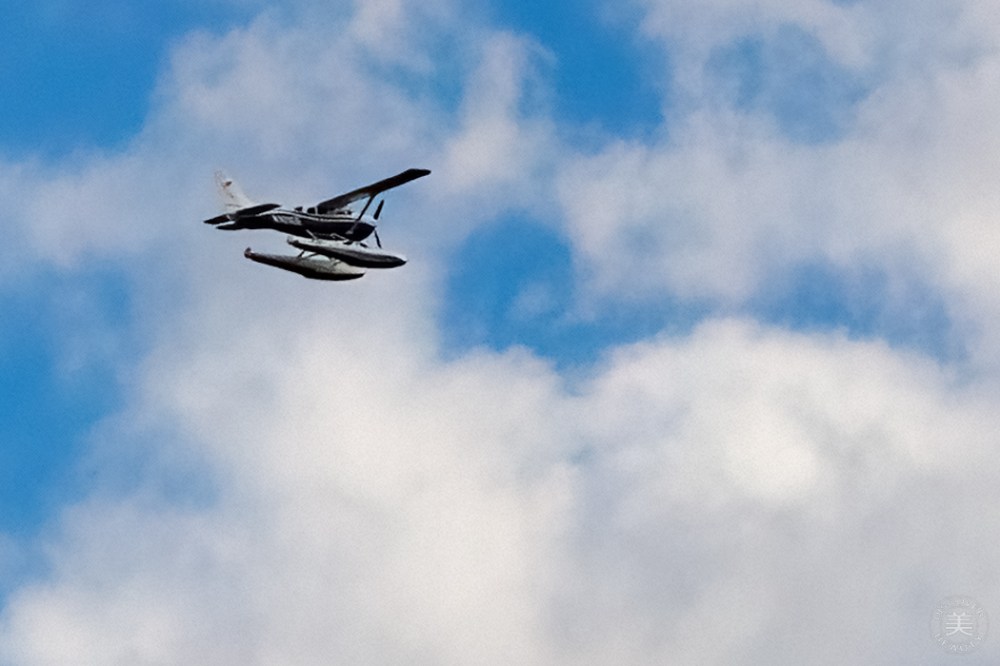
アラスカでは、60人に一人はパイロットライセンスを持っているそうです。飛行機がいかに重要な役割を果たしているかがわかります。下の写真はフロート飛行機です。夏は水上フロート、冬は雪上スキー用へと足を付け替えられる様にでできているそうです。ほほ〜。そんな話を聞きながら、アンカレッジの空港につきました。 We heard that one out of 9 people in Alaska has a pilot license. This shows that the airplane is a very important part of their lives. The picture below is a float airplane. The legs are interchangeable. You can have floats in summer, and skies in winter. How convenient is that?
空港で発見した、本屋さん。名前は「モスキート書店」蚊の絵までついています。アラスカの州鳥は雷鳥です。でも裏の州鳥は蚊だと言われるほど、蚊が多い州です。バッチリ蚊除けスプレーをして行きましょう。At Anchorage airport, we found a bookstore named “Mosquito Books”. Alaska’s state bird is the Willow Ptarmigan. But people say the unofficial state bird is the mosquito, because mosquitos are everywhere in the state and they are so big. Bug spray is a must item if you visit Alaska.
アラスカ旅行記、これでおしまいです。次回は春、カトマイ国立公園に行けたらいいな。それまで、またね、アラスカ! So, this is it. This is the end of my Alaska vacation journal. If possible, I want to visit Katmai National Park next time. Until then, farewell Alaska!
アラスカに別れを告げる前日、心配された天候もなんとか持ち堪えてくれたので、遂に氷河との遭遇ができました。 It was one day before we said good-bye to Alaska. Thanks to the fact that the weather held somewhat, we could finally make the close encounter to a glacier.
ヘリコプターは、雨にも負けず氷河の上をズンズン進みます。 Our helicopter went on and on above the glacier even though rain came down all around.
美しい氷河の模様に魅せられて、この時点で100枚ぐらい撮っていますが、その中の一枚です。 The magical view and gorgeous pattern of the glacier captivated me, and I took nearly 100 pictures of them. This is only one of them.
無事、氷河に着陸。 We landed safely on the glacier.
アイゼンの簡易バージョンを登山靴につけました。簡易すぎて氷をグリップしてくれないようで心配でしたが、ともあれ、氷河に降り立ちました。 We put on a very simple set of crampons. I felt that the crampons didn’t grip the ice that well, but in any case, I stood on the glacier.
雨も降っていたため、それほど長く歩き回ったわけではありませんが、再び興奮して写真撮りまくりでした。 Because of the rain, we didn’t stay there very long, but still, I was so excited and took so many picture there.
氷河は青い。 The glacier is blue.
帰りのヘリコプターからの眺めは、またさらに美しかった。 The views on the way back to the helicopter station were as beautiful as the glacier.
悪天候で飛べないかと心配されたヘリコプターにも乗れて、本当にラッキーでした。 We were indeed lucky that we could fly out there as the weather could have been even worse.
オスのムースが枝の皮を剥いているところ見たり、 We watched a bull moose chewing off a branch balk, and…
ゴールデンベアたちが水浴びするところを見たりしました。 watched golden bears’ bathing.
その他、あらゆる動物が保護されていました。 And we saw many other animals that were protected.
ふと、写真家が立ち止まりました。はたして、この動物はなんだろう? 笑 And suddenly, a photographer stopped walking. He must be thinking what kind of animal it could be. hahaha
私の一番見たかった動物はヤマアラシです。 The animal I wanted to see most was the Porcupine.
はじめまして。どうぞよろしく。 Hello. It’s nice to meet you.
こんなシッポなんだ。 Oh my! Its tail is like this.
どうやらアメリカヤマアラシは日本やアジアのヤマアラシとは少々違う様です。 It looks like the North American Porcupine is different from the Old World Porcupine.
さあ、先を急ぎます。さようなら、ヤマアラシ。さようなら美しい自然。 We better move on now. Good-by Porcupine and majestic mountains.
再びバスに乗り、アンカレッジから車で1時間弱のリゾート地、そして最後の場所、アリエスカに辿り着きました。 早く家に帰りたいなぁという気持ちと、もう帰っちゃうという気持ちが交錯していました。 We hopped on a bus, and finally came to the final destination of Alyeska. It is a resort town. This place is less than one hour from Anchorage. I had mixed feelings, both “want to go home soon” and “want to stay longer.”
気ままに一人で歩きたくなって、他の人たちがガイドツアーをしていある間、気ままに一人でトレイルを散策しました。 While other people were taking the guided tour of the park, I wandered around and explored on my own.
雨に濡れて、野草が美しい。10種類ほどの植物の写真を撮ました。その中から、2種、ここに載せます。The wild flowers and plants were so pretty in the rain. I took about 10 different plant pictures. But for now, I want to show you two of them.
シトカ カノコソウです。小さな花を花束のようにたくさん付けて、雨で暗くなった空の下、白さが際立ち魅せられます。 This is Sitka Valerian. Under the dark rain clouds, the clustered tiny white flowers stand out.
近寄って見ると、雨の滴が落ちそうで落ちない。なんだか私の心を温かくしてくれました。 When I looked closely, I found rain drops had almost fallen down but were still there. Such a sight made my heart warm.
花が散った後には、こんな丸いものがついています。これは花の実でしょうか?この花は、アラスカから南はカリフォルニアまでの高原地帯に咲いているそうです。 After the flowers fell off, it formed dark purplish round things like in the picture below. Are they fruits or seeds? This flower lives on high mountain ranges from Alaska to California.
こちらはアラスカの野草、チシマフウロです。ゼラニウムの一種ですが、高山に生息します。雨の中だと花はみんなより綺麗に見えます。 This is an Alaskan wildflower, the Woolly Cranesbill. It is in the Geranium family and lives in high mountains. It’s magical that the rain transforms all the flowers to be even more beautiful.
雨水が無数に生えた毛に付いて、美味しそう。 Is it strange to say that it looks yummy, like a candy with rain drops on the tiny hairs on the flower buds?
散策中、ピョンピョン飛んだり歩いたり、私の歩く後をついて来てくれたキガシラシトドです。一緒に花の観察をしてくれて、ありがとう! This is a Golden-crowned sparrow. It hopped and walked, and followed me while I was wandering around. Thank you for observing flowers together with me!
朝4時ごろに目が覚めていました。アラスカの夏は午前3時にはすでに明るくなっています。まだ誰も起きていないシンとした朝、カメラを持って朝食前の散歩に出かけました。 I was already awake at 4 o’clock in the morning. Alaska’s summer days start early. It was already bright enough at 3 o’clock to see things outside. So we went out into the very quiet morning air for a walk with our cameras.
バンちゃんが道路脇にまだ新鮮な足跡を見つけました。これは、もしかして例のあの動物かもしれない。 Banchan found a few sets of fresh animal tracks. We thought it could belong to the animal we want to see.
足跡を辿っていくと、やっぱり、いました。ヘラジカのお母さんと子供。 We followed them, and indeed, we found a mother moose and her cub.
明るいとはいえ、カメラの感度を上げるほど明るくはなく、ISOを3200に上げても1/6秒のスピードです。カメラ調整している時間はありません。またしても絶好のチャンスなのに準備ができてなくてもどかしさを感じてました。 It was already bright enough to see outside but not enough for the camera’s sensitivity. I quickly raised ISO to 3200 but the shutter speed was still 1/6 of a second. I didn’t have time to adjust my camera. I regretted so much why I didn’t prepare for such a great opportunity.
ビデオならなんとかなるかと、祈る思いで撮ったのが以下です。画面がすごくブレてます。そんな質の悪いビデオをシェアするのは心苦しいのですが、雰囲気はやはりビデオじゃないとわからないので載せておきます。 So, I gave up pictures, and switched to video mode hoping that it was somewhat better. I made the video below by combining 4 videos out of 6 I had taken. Unfortunately, the quality is so bad because I couldn’t hold my camera still while walking backwards. But I still think you can see the feeling of the scene.
野生動物との距離の取り方のポスターを見つけました。 By the way, this is a poster talking about “social distance”.
これによると、ヘラジカとは100mぐらい距離を置かなければいけないそうです。私たちの場合は、気がついた時にはすでに30mぐらいの距離でした。 It says that we need 300 ft with a moose to be safe. For us, it was probably 100 ft when we found them.
しかも、子供が私たちに興味を持ち、どんどん近づいてきました。お母さんが横の方でしっかり状況を見つめています。 On top of that, the cub thought we were interesting objects, so he kept coming towards us. We knew his mom was looking at the situation carefully.
すっごくヤバイ。 It was, indeed, a very very dangerous situation.
それでも、静かに、静かに後退りを繰り返しながら撮影しました。途中、お母さんにやめなさいと言われたのかもしれません。諦めて林の中に入っていきました。ホッとしました。野生動物を見たいけど、こんな至近距離での出会いはしたくない。 We tried to keep ourselves calm, and walked backwards slowly and quietly while I video taped occasionally. At one point, the cub stopped coming towards us. Maybe his mom told him “that’s enough.” Then he went into bushes. What a relief I felt then. I want to have wildlife encounters, but not this close.
ところがその後、ホテルへの帰り道、道路で再び出会ってしまいました。お母さんが私たちを一喝するように見つめ、歩き去っていったのを見て再び安堵しました。 On the way back to our hotel, we met them again on the paved road. The mother moose looked at us as if she was scolding at us. “Leave us alone!” Then they went away. What a relief, yet again.
ドキドキ興奮する、アラスカの早朝でした。 It was a truly exciting morning in Alaska.
コッパーセンターという町について何も知りません。移動の途中で一泊した場所でした。クルティナ川沿いのログキャビン風の宿で、しかもまだラングルイライアス国立公園が目の前の川向こうに見えていました。晴れていたら絶景が目の前にあった事でしょう。観光用ヘリコプターが時折発着してました。 I don’t know anything about the town, Copper Center. We stayed there one night on the way to the next destination.
雨がちらつく曇り空の中、何も見えませんでしたが、それでもこの地が記憶に残っている理由はジニーと出会ったからです。 We couldn’t see anything due to the rainy weather, but I remember this place very well because I met Ginny.
生後7週間のスタンダードプードルの子犬です。 Ginny is a seven week old red standard poodle puppy.
バスの運転手の奥さんが連れてきてくれました。抱いてあげるとまだ震えていました。信じられない可愛さ。夕食後10分程度の出来事でしたがズッシリと記憶に残りました。 Our bus driver’s wife brought her there for us. Ginny was shaking when I held her. She was so tiny and incredibly cute! Getting to hold her only lasted 10 minutes, but it became an important part of my Alaska trip and one of my best memories.
ランゲル・セントイライアス国立公園は、アメリカ合衆国で一番面積の広い公園です。どれほど大きいかというと、53,321平方メートルあり、イエローストーン国立公園の6倍、九州全県含めてもまだ及ばない大きさです。 Wrangell-St. Elias National Park is the largest National Park in the United States. It’s 13,175,799.07 acres, so huge that it is more than six times the size of Yellowstone National Park and bigger than the state of Maryland.
この日、私たちは小型飛行機で公園内のマッカーシーに飛び、そこからケネコット銅山跡地に向かいました。 We flew into McCarthy airport in the park, then went to Kennecott mine that day.
茶色に見えるのは氷山です。その真横に立つケネコット銅山。The foreground brown color is Kennecott glacier. The Kennecott mine stands right next to it.
この銅山は1900年に活動を始め、1938年に閉山しています。その間、第一次世界大戦が起こっていることを考えると、この銅山がいかに活性化していたかわかります。 The mine started from 1900 and closed in 1938. Considering that World War I started and ended during that time, I can imagine how active this place was.
この非常な寒さの中、物資運搬だけでも大変だった様です。でも、病院、学校、リクリエーションセンターなども作られて、ここでの厳しい生活を少しでも改善しようとしていた跡が見えました。 The severe weather made everything so hard to do including carrying things and goods to and from the nearest depot. Yet we could see that the mine owners tried to make the life here good enough for workers by making a hospital, a school, a recreation center, etc.
また、銅の製錬過程も興味深かったです。でも、私にはちょっと複雑ですでに忘れてしまいました。The tour guide for the mine gave us a very good explanation of how the mine was operated and the process of the mill, but it was quite complicated for me and I already forgot.
さて、銅山の帰りの飛行機からの眺めは素晴らしかったです。背の高い欧米人の中でチビっこい私が撮れた写真には限りがありますが、それでも素晴らしい。何はともあれ特記する写真はこれです。 We hopped back on the plane again after that, and enjoyed the grand views from the airplane window. I was only a tiny woman among all the tall people, which made it difficult to take pictures, but I still managed to take some. This is one of the most important pictures that I took that day.
マウントブラックバーン山から続いているケネコット氷河がハイウェイの様に流れています。マウントブラックバーンは雲に隠れて見えません。標高4996m、北アメリカで12番目に高い山です。この氷河が銅山の前にも到達しているんです。 Kennecott glacier is coming out from Mount Blackburn, and running down like a highway. The mountain itself was behind the clouds and we couldn’t see it. The height of the mountain is 16,391 ft, the 12th highest mountain in the North America continent, and a part of the Wrangell mountains.
もう一つ書いておきたい事は、グレイシャーシルト(氷河の泥)です。下の写真に写っている水溜りは氷河が溶けて出来ました。溶けると濁った水になるんですね。だから氷河に近い川はみんな濁っています。その為、ほとんどの魚は生息していません。でも、その中でも元気に泳いでいる魚も、勿論います。 Another thing I want to write about is “Glacier silt”. The picture below shows a small lake that was made by melt water from the glacier. The glacier ice contains much finely ground earth. Therefore the melt water filling all the rivers near the glacier are silty like this and not many fish live in the silty rivers.
他にも私好みの抽象画のような写真がたくさんあって、(自分で撮ったので当然ですが)どれを選ぼうか悩みました。 It was very hard to choose a few pictures for this blog because they are my kind of abstract pictures. (silly me… of course I like them since I took them.)
ツンドラ地帯と氷河が高いところか見ると、ちょっと似ていると思うのは私だけでしょうか。 The tundra area and the glacier look alike from high above. Could it be only me who thinks this way?
コッパーセンターという町に行く途中、バスの中から見えた景色です。公園の景色ならいいな。氷河の先の一番奥の方がランゲル山地ならいいなと思いながら撮りました。 This is a view from the bus through the window on the way to get to the next destination, Copper Center. I took this picture hoping that it’s a view of Wrangell-St. Elias National Park, and the far end of the glacier were the Wrangell mountains.
ランゲル山地は火山でできた山々です。中でもランゲル山はまだ活動している山とされています。対照的に、セイントイライアス山は2つの大陸、北アメリカと太平洋、がぶつかり合い、隆起して出来た山です。 そんな対照的な山を含むからでしょうか。二つの有名な山の名前がそのまま公園の名前になったのかもしれませんね。Wrangell mountains were made by volcanic activity, and Mt. Wrangell is still an active volcano. It’s interesting that Mt. Saint Elias was made by the movement of two plates, the North American plate and the Pacific plate. This park includes these two mountains contrasting each other, and maybe that is why it is called Wrangell-St. Elias National Park.
氷河に圧倒され、言葉になりませんでした。以下、16枚だけを選びに選び抜いて、それぞれにコメントしました。 I was overwhelmed by the Glacier, and can’t find words to express it. It was very difficult to choose only 16 pictures, but here they are. I added a comment to each pic.
ラッコ Sea Ottersくじらの尾ビレ Whale flukeシャチ Orca氷山 Iceberg氷山 Iceberg氷山 IcebergIceberg何も見えないけど、氷河が近い。 Although we couldn’t see anything, Glacier was getting closer.見えた!I can see it!氷河 Glacier氷山の上に鳥が止まっている。Birds perched on an iceberg.ミツユビカモメの脚は黒い。Black-legged Kittiwake is a gull, but note the black legs.氷が直接海の中に入り込んでいる。Glacier goes into the water directly.帰る前にもう一枚。Right before going back to the port.氷をリサーチに使うそうです。They use it for their research.
私たちを乗せたバスはランゲル・セイントイレリアス国立公園を左手に南へと走りました。 Our bus continued south with Wrangel St. Elias National Park to the left of us.
氷河はバスの中からもいくつも見えました。 We could see many glaciers through the bus windows.
また、氷河が溶けて流れ出し、道路脇にはいくつもの滝を見かけました。 We also saw many water falls by the road as a result of glacier and snow melt.
そして、ついにバルデスという港町に辿り着きました。 And we finally arrived at the small fishing town of Valdez.
長旅の後の漁港ということもあり、嬉しくて1000枚以上、写真撮りまくり状態となりました。 I was so happy to be there after the long bus ride, I took more than 1000 pictures.
ここでも雨がぱらつく天候で、近くの山は雲や霧に隠れて見えませんでした。 The weather was still overcast and rainy, so we couldn’t see the nearby mountains.
でも、どの風景もいい。 But I loved them all.
どのショットがこの町を表すことができるのか、とても悩みましたがこの6枚を選びました。I had a hard time choosing pictures for this blog to represent the town, but these are 6 pictures out of 1000.
翌日、私たちは船に乗ってコロンビア氷河を見に行きました。 We went to see Columbia Glacier by boat the following day.
デナリ ハイウェイ(アラスカ8号線)は南北に走る東のアラスカ4号線と西の3号線の間を東西に走り連結する、全長217kmのハイウェイです。 Denali Highway (Alaska Route 8) is 135 miles in length, and runs between Alaska Route 4 on the east, and Alaska Route 3 on the west.
もともと、地図上中央にあるベルデスクリーク金鉱から物資を運ぶために作られた様ですが、現在はデナリ国立公園へのもう一つのルートとなりました。 It was made to carry things from and to Valdez Creek Gold Mine originally. But now it became another route to get to Denali National Park.
とはいえ、舗装されている部分とされていない部分とがあり、それほど整備されているわけではありません。 Having said that, the road is not very well maintained. It’s paved partially, and not paved partially.
その理由の一つには永久凍土があるからです。永久凍土とは一年中摂氏0度以下で、氷の様に固まっている土壌のことです。 One of the reasons why it’s rather wild is because of the Permafrost. Permafrost is frozen ground that doesn’t thaw even in the summer because the temperature is below freezing.
夏に0度以上になると部分的に融解し、その上に作られた舗装はぐにゃぐにゃになってしまうことになります。 During the summer, certain parts of the permafrost melts, breaking the pavement.
勿論、道路だけでなく、建物も被害を受けます。そのため、この地方の建物は永久凍土対策として杭を深く打ち込み、地面とは少し距離を置いて家を建てています。 Permafrost will destroy building foundations also. Therefore, people around this area build houses above the ground by anchoring poles deep in the ground.
タイガと時折見える永久凍土の融解によってできた水たまり。そして遠くに見える山々は、晴れていたら、さぞかし素晴らしい眺め立ったことでしょう。I am imagining that the view must be wonderful if it were a clear day with the spruce taiga forest, many ponds on the permafrost, and Alaska mountains in the background.
デルタジャンクションへの道が通行止めになってしまったために、急遽変更してローカルの小さなガコナというビール増醸所を訪れました。 We were told that the road to get to Delta Junction was closed. So we changed plans, and went to a beer brewing company, called Gakona.
種類は5種類あり、それぞれのウサギの絵がかわいい。 They have five different beer types, and a cute rabbit picture to represent each beer type.
特に2段目のビールは持ち帰りたかった。 I almost wanted to bring these beers home in the picture below.
客の一人が連れて来ていた犬までお店にピッタリな様相。バスの長旅を癒してくれました。 I found a dog in the shop leashed by one of the customers. He was perfect to be there in this shop. Beer and dog comforted me and removed the fatigue from the long bus ride.